Guide · 7 min read
History of Christmas: From December 25 to the Santa Tracker
The short answer: Christmas marks the birth of Jesus, but the Bible never says when he was born; December 25 shows up in the records centuries later. Many customs that feel ancient are fairly young. The Christmas card, the decorated tree in Britain, Dickens's "A Christmas Carol" and the American Santa Claus all took shape in the 1800s, and electric tree lights arrived in 1882. In between, Puritans banned Christmas outright, both in England and in colonial Massachusetts.
Why is Christmas on December 25?
Nobody knows the real date. The Gospels describe the birth but never give a date, not even a time of year. A few Christian writers proposed December 25 in the 200s, and the oldest surviving calendar that marks it as Christ's birthday is a Roman almanac from the mid-300s. Its entry for the day reads "natus Christus in Betleem Judeae": Christ was born in Bethlehem of Judea.
Why that day is still argued over. One theory says the church picked it to replace pagan midwinter feasts, such as the feast of the Unconquered Sun that the Roman emperor Aurelian set on December 25 in 274. Another says early Christians calculated it, counting nine months on from March 25, a date some of them linked to Jesus's conception. Historians have not settled it.
Some early churches kept the birth on January 6 instead, and the Armenian church still does. In the end most settled on December 25, and January 6 became the Feast of the Epiphany, which marks the visit of the Magi. The days in between became the Twelve Days of Christmas.
Was Christmas ever banned?
Yes, and both times by Puritans, who found no warrant for the feast in the Bible and disliked the drinking and disorder that came with it. On June 8, 1647, England's Parliament passed an ordinance abolishing Christmas, Easter and Whitsun as festivals. To make up for the lost holidays, a second ordinance gave apprentices and servants a day of rest on the second Tuesday of every month. The ban was never popular, and Christmas brought riots, including one in Canterbury in 1647. The fight over Christmas ended only in 1660, when the monarchy was restored.
The Puritans of New England went further. In 1659 the General Court of the Massachusetts Bay Colony passed a law that punished anyone found "observing any such day as Christmas," whether by not working, by feasting or "any other way." The fine was five shillings, and the law stayed on the books until 1681, when the colony repealed it under pressure from London.
When did Christmas become a US holiday?
On June 28, 1870, President Ulysses S. Grant signed the first federal holiday law. It made New Year's Day, Independence Day, Thanksgiving and Christmas Day holidays, but only for federal workers in Washington, D.C. Federal employees in the rest of the country apparently did not get the days off until 1885.
How did the Victorians reinvent Christmas?
The 1840s gave Christmas three of its fixtures. In 1843 Henry Cole, who later became the founding director of London's Victoria and Albert Museum, commissioned the first commercial Christmas card. His friend, the artist John Callcott Horsley, drew the design, and 1,000 copies were printed for sale at a shilling each. That was a lot of money at the time, and the cards were judged a commercial flop, but the idea lasted.
That same December, on the 19th, Charles Dickens published "A Christmas Carol." The first printing of 6,000 copies, at five shillings a book, sold out by Christmas Eve.
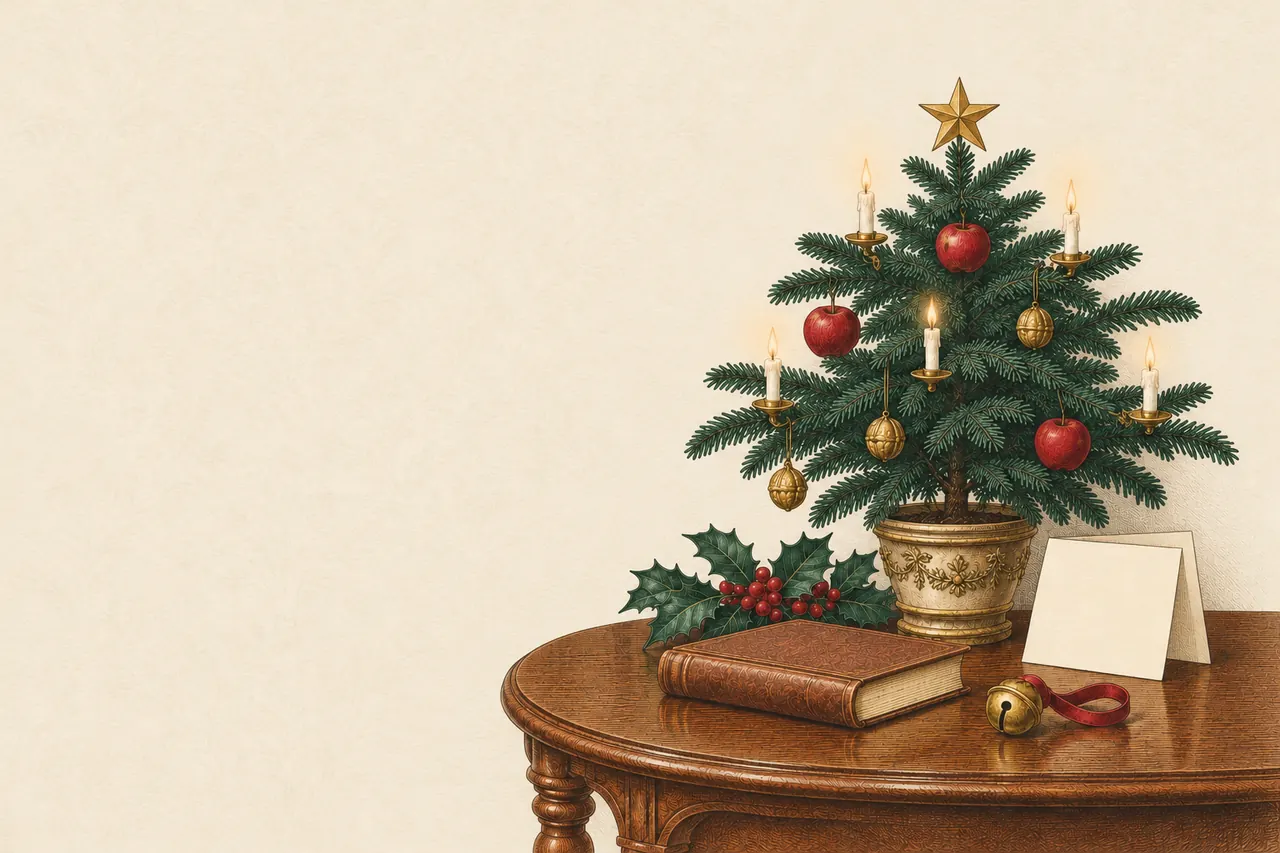
The decorated tree came from German lands: fir trees hung with apples are on record in Strasbourg in 1605, and candles on trees in 1611. Britain took it up through its royal family. In 1848 the Illustrated London News printed a picture of Queen Victoria, Prince Albert and their children around a decorated tree, and families across Britain copied it.
Where did Santa Claus come from?
From a saint. Saint Nicholas was probably a bishop of Myra, in what is now Turkey, in the 300s; little else about him is certain. In many countries children still get presents on his feast day, December 6. After the Reformation he faded from much of Protestant Europe but lived on in the Netherlands as Sinterklaas, and Dutch settlers brought him to New Amsterdam, later New York. There, English-speaking Americans turned him into Santa Claus.
Two works gave the American Santa his shape. The poem "A Visit from St. Nicholas," which begins "'Twas the night before Christmas," was first published anonymously in the Troy Sentinel, a New York newspaper, on December 23, 1823. It describes Santa's sleigh and names eight reindeer, two of them Dunder and Blixem. Clement Clarke Moore claimed it as his own in 1844, but the family of Henry Livingston Jr. argued that Livingston had written it, and the dispute continues.
Then came the pictures. In its issue of January 3, 1863, in the middle of the Civil War, Harper's Weekly printed Thomas Nast's "Santa Claus in Camp," in which Santa hands out gifts to Union soldiers. Nast drew Santa many more times in the years that followed.
And the red suit? It is often said that Coca-Cola dressed Santa in its brand colors, but the company itself says he wore red before its artist, Haddon Sundblom, first painted him for its ads in 1931.
What was the Christmas truce of 1914?
In December 1914, in the first winter of the First World War, British and German soldiers stopped fighting along parts of the Western Front. In many places it began with German soldiers singing carols and putting Christmas trees on top of their trench parapets. Some units used the pause to collect and bury their dead; in other places men met in no man's land and talked. There was some football, but it was kickabouts, not organized matches. The truce was not kept everywhere, and after 1914 the high commands on both sides tried to stop anything like it from happening again.
Where do two famous Christmas songs come from?
"Silent Night" began as a poem by Joseph Mohr, a young assistant priest in Austria. On Christmas Eve 1818, Mohr asked the church organist, Franz Xaver Gruber, to write a melody for two voices and a guitar, and that night the two men sang it in the church of St. Nicholas in Oberndorf, near Salzburg in Austria.
"Jingle Bells" holds a different record. In December 1965, the astronauts Wally Schirra and Tom Stafford, orbiting Earth in Gemini 6, played "Jingle Bells" on a small harmonica and a set of sleigh bells. Just before, they had reported an unidentified flying object that seemed to be trying to signal them. They were the first musical instruments played in space, and both are now in the Smithsonian's National Air and Space Museum.
Who put the lights on the tree?
Before electricity, trees were lit with candles, which started many house fires. In 1882 Edward H. Johnson, a friend and business partner of Thomas Edison, hand-wired 80 red, white and blue bulbs and wound them around his Christmas tree in New York City. It was the first string of electric lights made for a Christmas tree.
Forty-one years later, the lights went public. On Christmas Eve 1923, President Calvin Coolidge pushed a button to light the first National Christmas Tree, a 48-foot balsam fir from Vermont, on the Ellipse south of the White House. Presidents have taken part in the lighting ever since.
Why does NORAD track Santa?
Because of a wrong number. In 1955 a Sears newspaper ad invited children to phone Santa, and at least one caller dialed wrong and reached Colonel Harry Shoup at the Continental Air Defense Command (CONAD) in Colorado Springs, which watched the skies for a Soviet air attack. The next year, news agencies called to ask whether his team would track Santa again. In 1958 the newly created North American Aerospace Defense Command, NORAD, took up the tradition, and it has tracked Santa every Christmas Eve since.
Why is Christmas written "Xmas"?
Not to take Christ out of Christmas. The X is the Greek letter chi, the first letter of Christos, the Greek word for Christ. Christian writers used it as a shorthand for his name for centuries, and Merriam-Webster dates the first known use of "Xmas" to 1721.
Christmas timeline
- Mid-300s — A Roman almanac marks December 25 as Christ's birthday.
- 1605 — Fir trees hung with apples are recorded in Strasbourg.
- 1647 — England's Parliament abolishes Christmas as a festival.
- 1659–1681 — Massachusetts Bay fines anyone who keeps Christmas.
- 1660 — The monarchy returns to England, and the fight over Christmas ends.
- 1818 — "Silent Night" is first sung, in Oberndorf, Austria.
- 1823 — "A Visit from St. Nicholas" is published.
- 1843 — The first commercial Christmas card; "A Christmas Carol."
- 1848 — The royal family's tree appears in the Illustrated London News.
- 1863 — Thomas Nast's "Santa Claus in Camp."
- 1870 — Christmas becomes a US federal holiday.
- 1882 — The first electric Christmas tree lights.
- 1914 — The Christmas truce on the Western Front.
- 1923 — The first National Christmas Tree.
- 1931 — Haddon Sundblom's first Santa for Coca-Cola.
- 1955 — The Santa tracker begins.
- 1965 — "Jingle Bells" is played in space.
Sources
- Biblical Archaeology Society — How December 25 became Christmas
- Encyclopaedia Britannica — Christmas
- British History Online — June 1647: An Ordinance for Abolishing of Festivals
- The History of Parliament — Parliament and Christmas during the Civil War
- Mass Moments (Mass Humanities) — Christmas celebration outlawed, 1659
- Congressional Research Service — Federal Holidays: Evolution and Application (98-301)
- National Park Service — Did Ulysses S. Grant pawn his watch to buy Christmas gifts?
- Victoria and Albert Museum — The first Christmas card
- Library of Congress — Highlighting the holidays: a tale of two publishings
- Royal Collection Trust — A royal Christmas
- Encyclopaedia Britannica — Saint Nicholas
- Encyclopaedia Britannica — A Visit from St. Nicholas
- The Metropolitan Museum of Art — Thomas Nast, Santa Claus in Camp
- The Coca-Cola Company — Haddon Sundblom and the Coca-Cola Santas
- Imperial War Museums — The real story of the Christmas truce
- History Today — The first performance of 'Silent Night'
- Smithsonian National Air and Space Museum — Bells, Gemini 6
- Smithsonian Magazine — When instruments were played in space for the first time, it was 'Jingle Bells'
- Library of Congress — Who invented electric Christmas lights?
- National Park Service — History of the National Christmas Tree
- Smithsonian Magazine — Why NORAD tracks Santa Claus
- Merriam-Webster — Xmas
Written and checked by the TakaQuiz team (Fiveupclub Inc). Published . Found a mistake? Email hello@takaquiz.com.