Guide · 4 min read
History of Halloween: From Samhain to Trick-or-Treat
The short answer: Halloween is the eve of All Hallows' Day, the Christian feast of All Saints on November 1. That date overlapped with Samhain, the Celtic festival that marked the end of the harvest and the start of winter. Customs from Ireland and Scotland, such as lanterns carved from turnips and going door to door in disguise, reached North America with immigrants in the 1800s. There, pumpkins replaced turnips, and the phrase "trick or treat" first appeared in Canadian newspapers in the early 1900s.
What was Samhain?
Samhain (pronounced "SOW-in") was a Celtic festival held around November 1. It marked the end of the harvest and the beginning of winter, the dark half of the Celtic year. Medieval Irish stories describe it as a night when the boundary between this world and the otherworld grew thin, and as a time for bonfires and gatherings.
A word of caution: most of what we know about Samhain comes from Irish texts written down by Christian monks centuries later. Historians agree that Halloween borrowed from it, but they argue about how much, so treat any claim that a modern custom is "2,000 years old" with care.
Where does the name Halloween come from?
From "All Hallows' Eve," the evening before All Saints' Day. "Hallow" is an old English word for a saint or holy person, so All Hallows' Day is simply All Saints' Day, November 1. The evening before it was All Hallows' Even, which Scots shortened to Hallowe'en.
All Saints' Day was not always in November. In the 8th century, Pope Gregory III dedicated a chapel in St Peter's in Rome to all the saints on November 1, and in 837 Pope Gregory IV ordered the feast kept everywhere. Some historians think the church chose the date to replace Samhain; others think it had nothing to do with it. All Souls' Day, for praying for the dead, was added on November 2 around the year 1000.
Why do we carve jack-o'-lanterns?
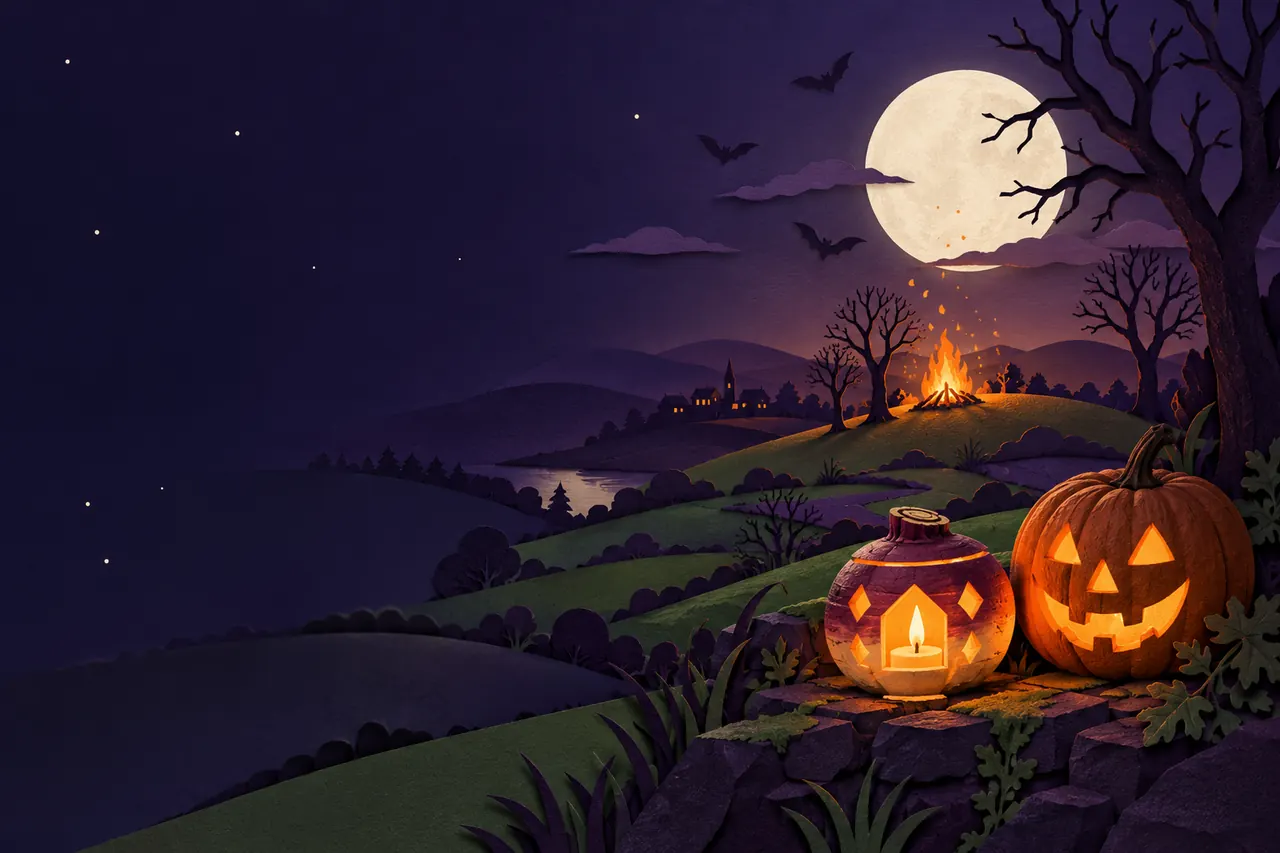
Because of an Irish folk tale and a vegetable swap. In Ireland and Scotland, people carved faces into turnips (and sometimes potatoes or beets) and set them in windows or by doors to scare off wandering spirits. In Irish folklore, the name is explained by the tale of Stingy Jack, a man who tricked the Devil. When he died, he was let into neither heaven nor hell, and he wanders the earth with a burning coal inside a carved turnip: "Jack of the Lantern."
Immigrants who brought the custom to North America found that pumpkins, which are native to the Americas, were bigger and much easier to carve. The pumpkin jack-o'-lantern is an American invention.
Where did trick-or-treating come from?
From two old door-to-door customs. In medieval Britain, on All Souls' Day, the poor went "souling": they went from house to house and were given soul cakes, small spiced cakes, in return for praying for the family's dead. In Scotland and Ireland, young people went "guising": they dressed in disguise and visited homes, performing a song, a poem or a joke in return for fruit, nuts or coins.
The phrase itself is much younger than the custom. The earliest known printed uses of "trick or treat" come from Canadian newspapers: versions of the phrase appear in Ontario in 1917, and in November 1927 papers in Alberta reported children in the village of Blackie demanding "trick or treat" at front and back doors. The custom spread across the United States in the 1930s, and by the 1950s it was a fixture of American childhood.
How did Halloween come to America?
Mostly with Irish and Scottish immigrants in the 1800s. Many of America's Halloween customs arrived with Irish immigrants fleeing the famine of the 1840s, who brought their games, their lanterns and their stories. Scottish customs were already on record: Scotland's national poet, Robert Burns, described Halloween customs in his 1785 poem "Halloween," including fortune-telling games played with nuts and kale stalks to see who you would marry.
Is the Day of the Dead the same as Halloween?
No. Día de los Muertos, the Day of the Dead, is celebrated in Mexico and other parts of Latin America on November 1 and 2. Families welcome back the spirits of loved ones who have died with home altars, marigolds, food and sugar skulls. It combines Indigenous traditions with the Catholic feasts of All Saints and All Souls. It falls right after Halloween and both involve skulls and costumes, but its tone is warm and remembering, not spooky.
Halloween timeline
- Before Christianity — Samhain marks the end of the harvest and the start of winter in Celtic lands.
- 8th century — Pope Gregory III dedicates a chapel in Rome to all the saints on November 1.
- 837 — Pope Gregory IV orders All Saints' Day kept everywhere; the night before becomes All Hallows' Eve.
- Around 1000 — All Souls' Day is added on November 2.
- Middle Ages — Souling for soul cakes in Britain.
- 1500s–1800s — Guising in Scotland and Ireland, which becomes a Halloween custom in the 1800s.
- 1785 — Robert Burns writes the poem "Halloween."
- Early 1800s — Carved pumpkin lanterns appear in America.
- 1840s — Irish immigrants fleeing the famine bring Halloween customs to America.
- 1917–1927 — "Trick or treat" appears in Canadian newspapers, first in Ontario, then in Alberta.
- 1950s — Trick-or-treating is a fixture of American childhood.
Sources
- Encyclopaedia Britannica — All Saints' Day
- HISTORY UK — The history of Halloween
- HISTORY — The history of the jack-o'-lantern and its Irish origins
- Historic UK — Halloween in Scotland
- The Canadian Encyclopedia — Halloween in Canada
- City of Edmonton Archives — Trick or treat
- Dictionary of Canadianisms on Historical Principles (UBC) — trick or treat
- PBS NewsHour — What is Día de los Muertos?
Written and checked by the TakaQuiz team (Fiveupclub Inc). Published . Found a mistake? Email hello@takaquiz.com.